
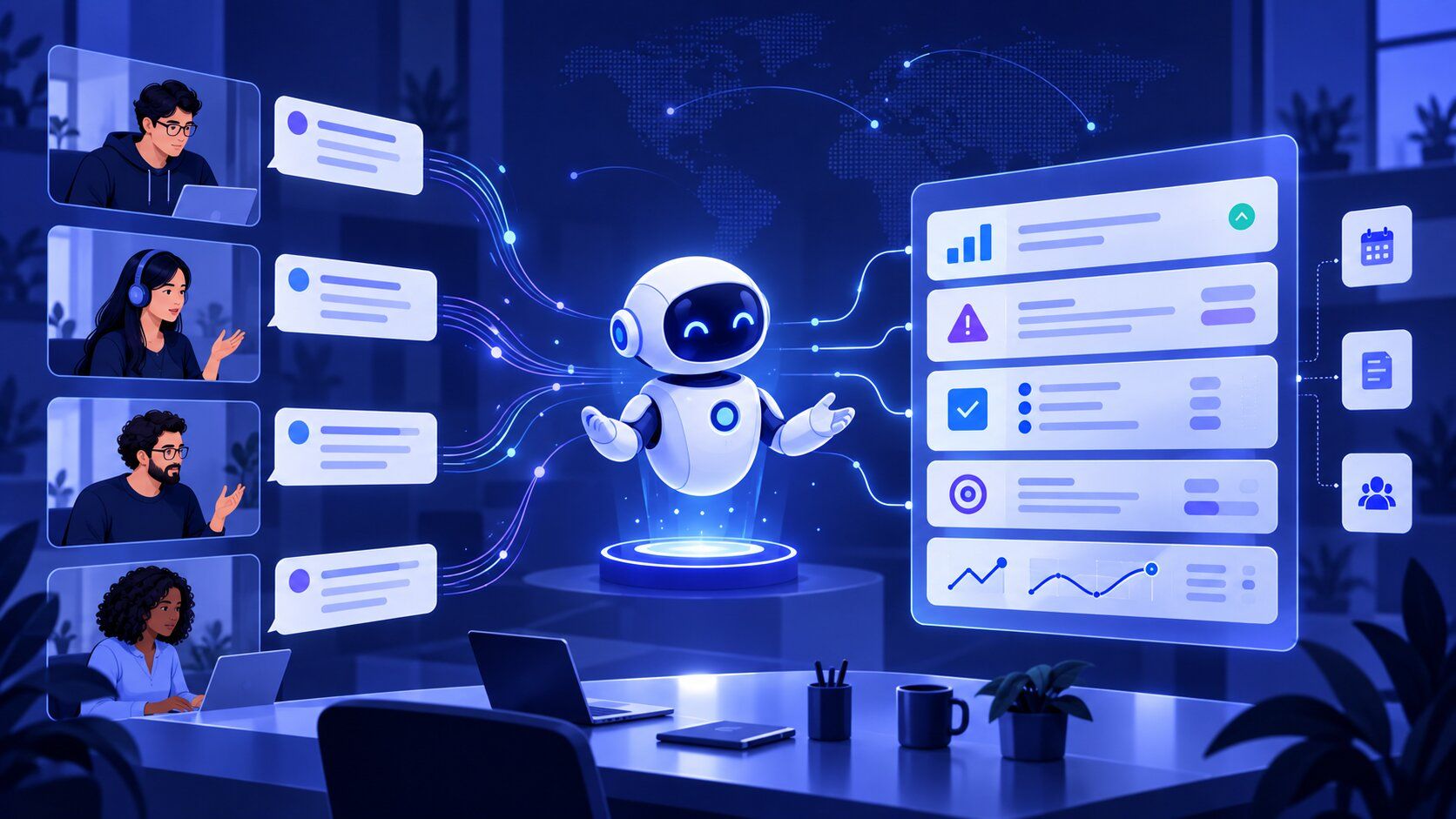
Daily standups are supposed to make engineering teams more aligned, not create another meeting that managers have to organize, facilitate, summarize, and follow up on.
That is where an **AI that runs daily standups** can be useful.
Instead of simply recording a meeting or generating a transcript, an AI standup facilitator can help structure the conversation, identify blockers, capture commitments, and turn what the team says into actionable project information.
For software and engineering teams, this creates an important shift: the standup becomes a source of delivery intelligence rather than another status meeting.
## What should an AI that runs daily standups actually do?
A useful AI standup should do more than ask everyone what they worked on yesterday.
The purpose of a Daily Scrum is to inspect progress toward the Sprint Goal and create an actionable plan for the next day. The official [Scrum Guide](https://scrumguides.org/scrum-guide.html) describes the Daily Scrum as a 15-minute event focused on progress, impediments, and the next plan.
That gives us a useful benchmark for evaluating AI standup software.
An **AI standup facilitator for engineering teams** should ideally help with five things:
1. Gather relevant updates.
2. Identify blockers and dependencies.
3. Capture commitments and action items.
4. Connect updates to actual project work.
5. Surface signals that may require a manager's attention.
The goal isn't to make the meeting more complicated.
The goal is to make the information produced by the meeting more useful.
## Why traditional daily standups often fall short
The standard format is simple:
- What did you complete?
- What will you work on today?
- Are you blocked?
Atlassian recommends a similar structure for software teams and describes the standup as a short meeting for understanding progress and identifying blockers.
The problem is what happens after everyone answers.
A team might say:
> "The API work is almost done, but I'm waiting for the authentication changes."
That sounds like a normal update.
But hidden inside that sentence are several pieces of project information:
- The API task is approaching completion.
- Authentication is a dependency.
- The dependency may affect the next piece of work.
- Someone may need to take action.
- The project manager may need to monitor the dependency.
A human Scrum Master or delivery manager has to recognize these signals, remember them, record them, and follow up later.
With multiple engineers, multiple projects, and multiple meetings, that becomes difficult to do consistently.
## AI standup software should capture more than summaries
One of the biggest differences between an AI standup assistant and a traditional meeting recorder is what happens to the information after the conversation.
A transcript tells you what people said.
A useful AI system should help answer:
**What changed?**
**What is blocked?**
**Who committed to what?**
**What needs attention?**
**Could this affect delivery?**
This is why keywords such as **AI that identifies blockers from standups**, **AI that turns standups into action items**, and **AI that tracks team commitments** represent a more valuable category than simple meeting transcription.
The AI is not merely documenting the meeting.
It is interpreting the operational information inside it.
[Specific descriptive alt text: AI standup workflow showing conversation transformed into progress, blockers, commitments, and action items](https://chatgpt.com/c/placeholder-image-url)
*Image Prompt:* Create a clean editorial workflow illustration showing four stages from left to right: engineering team conversation, AI interpretation, structured delivery signals, and project action. Visually represent standup discussion flowing into progress updates, blockers, commitments, action items, and risk indicators. Use navy, indigo, pale lavender, and white, subtle gradients, soft shadows, generous whitespace, minimal SaaS interface aesthetic, no logos, no embedded text, no circles, 16:9.
*Caption:* A useful AI standup turns conversation into structured delivery signals rather than stopping at a meeting summary.
## From standup updates to action items
Consider a simple update:
> "I'll finish the payment integration today and then review Sarah's PR."
A basic AI meeting assistant might summarize that sentence.
An AI standup system could instead recognize two commitments:
- Finish payment integration.
- Review Sarah's pull request.
This distinction matters because commitments can be connected to the team's existing work.
The result is a more useful workflow:
**Conversation → commitment → action → follow-up**
For an engineering manager, this means less manual note-taking and fewer forgotten follow-ups.
It also makes the phrase **AI that tracks action items from standups** particularly important when evaluating these tools.
The question isn't simply whether AI can summarize a meeting.
It is whether the system can help a team act on what was discussed.
## AI that identifies blockers from standups
Blockers are another important signal.
Suppose three engineers independently mention:
- waiting for API credentials
- waiting for design approval
- waiting for another team's database change
Each update may look relatively minor on its own.
Together, they could indicate that the sprint has several dependencies slowing execution.
A useful **AI Scrum Master that tracks blockers** should make those signals easier to see.
This does not mean AI should automatically declare that a project is at risk every time someone says "blocked."
Context matters.
The better approach is to combine conversational signals with project context and existing work data.
Jira, for example, provides mechanisms for identifying blocked work items and offers reporting capabilities for understanding project and sprint health.
That creates an opportunity for AI to operate above the project-management system rather than replacing it.
## Your project management tool already contains valuable context
Most engineering teams already have a system of record.
That might be Jira, Linear, or another project management platform.
The problem is that project systems and human conversations often contain different pieces of the story.
Your project system might say:
**Payment API → In Progress**
But the standup might reveal:
**"I'm blocked until the security review is complete."**
Those two pieces of information are different.
The task status describes the state of the work item.
The conversation explains why the work may not be progressing.
That is why an **AI standup that updates Jira** or an **AI standup automation with Jira** can be more useful than another isolated meeting application.
The AI can connect conversational context with structured project data.
Atlassian itself provides standup functionality inside Jira and reporting across projects, sprints, and work items, demonstrating how closely standup activity and project data can be connected.
## The next step: from standup automation to delivery intelligence
Automating a standup is useful.
But it is only the beginning.
Imagine an engineering manager starts the morning with:
**Sprint:** On track
**New blockers:** 3
**Unresolved commitments:** 2
**Dependency risks:** 1
**Work requiring attention:** 4
Instead of reading through ten meeting summaries, the manager can focus on the exceptions.
This is where an **AI project status reporting for software teams** workflow becomes valuable.
The standup is no longer an isolated event.
It becomes one signal inside a larger picture of project execution.
[Specific descriptive alt text: Engineering delivery dashboard connecting standup signals with project progress and delivery risks](https://chatgpt.com/c/placeholder-image-url)
*Image Prompt:* Create a premium B2B SaaS editorial illustration of an engineering delivery intelligence dashboard. Show conversational standup signals feeding into project progress, blockers, commitments, dependencies, sprint health, and delivery risk. Emphasize relationships between signals rather than dense charts. Cool navy, indigo, pale lavender, and white palette, subtle gradients, soft lighting, spacious composition, minimal interface details, no logos, no embedded text, no warm colors, 16:9 aspect ratio.
*Caption:* Standup information becomes more valuable when connected to the broader state of project delivery.
## What should teams look for in an AI Scrum Master?
If you're evaluating an **AI Scrum Master for engineering teams**, look beyond whether the product can conduct a conversation.
Ask these questions:
### 1. Can it actually run the standup?
The system should be able to guide the conversation instead of simply joining a call and producing a transcript.
### 2. Can it identify blockers?
Look for the ability to distinguish genuine impediments from ordinary discussion.
### 3. Can it track commitments?
A useful system should make it possible to understand who committed to what and whether those commitments remain open.
### 4. Can it connect conversations to project work?
This is where integrations with tools such as Jira and Linear become important.
### 5. Can it identify emerging delivery risks?
The real value of AI begins when individual updates can be connected to broader project patterns.
### 6. Can it reduce management overhead?
If managers still have to manually read every summary, create every task, and investigate every blocker, much of the potential value is lost.
## Where Huzlr fits
Huzlr approaches the problem from a broader perspective than meeting transcription.
The idea is simple:
**Your team shouldn't have to constantly pull information out of its project management system. The system should help push important information to the people who need it.**
Huzlr is designed as an agent-driven project management layer that can work with tools such as Jira and Linear while using conversations and project context to provide a clearer view of execution.
That means an AI standup can be one part of a larger workflow:
**Run the standup → capture progress → identify blockers → track commitments → connect to project work → surface delivery risk.**
This is the progression from an **AI standup assistant for engineering teams** to something closer to an AI project manager.
## AI standups are not about replacing the team
The best reason to automate a daily standup isn't to eliminate human communication.
It's to eliminate unnecessary coordination work.
The team still needs to discuss complex problems.
Engineers still need to collaborate.
Managers still need to make decisions.
But an AI system can handle much of the operational layer around those conversations:
- collecting updates
- organizing information
- tracking commitments
- identifying blockers
- updating project context
- highlighting exceptions
- preparing status information
That lets the humans spend more time solving problems and less time maintaining the machinery around project delivery.
## The future of the daily standup
The traditional standup asks:
**"What did you do?"**
An intelligent standup should help answer a much more useful set of questions:
**What changed?**
**What's blocked?**
**What did we commit to?**
**What is falling behind?**
**What needs attention?**
**Could something affect delivery?**
That is the real opportunity behind an **AI that runs daily standups**.
The value isn't the meeting itself.
The value is turning a few minutes of team conversation into continuous visibility across execution.
And once that happens, the standup stops being just another Agile ceremony.
It becomes a signal that an AI project management system can use to help teams stay ahead of delivery problems.