
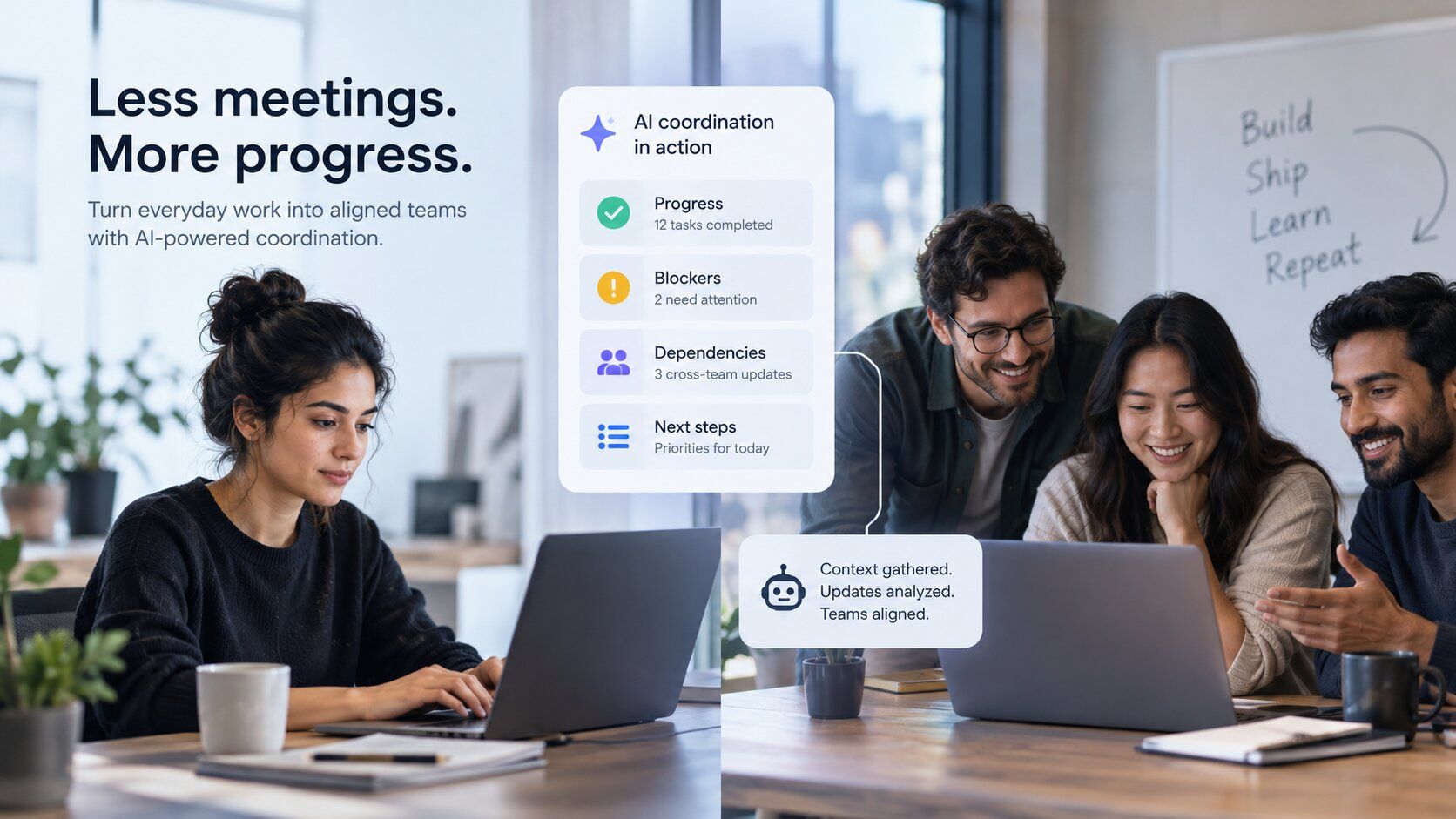
Daily standups are meant to improve coordination.
But there is a difference between coordinating work and reporting work.
The Scrum Guide defines the Daily Scrum as a 15-minute event for Developers to inspect progress toward the Sprint Goal and create an actionable plan for the next day.
That distinction matters.
A standup should help a team coordinate.
It shouldn't become a daily reporting ritual.
Do You Actually Need a Daily Standup Meeting?
Before removing a standup, ask what it is accomplishing.
Is the team:
- Identifying blockers?
- Coordinating dependencies?
- Adjusting work toward the Sprint Goal?
- Making decisions?
Or is everyone simply answering:
What did I do yesterday?
What am I doing today?
Am I blocked?
Those questions are useful.
But they don't always require everyone to be in the same meeting at the same time.
Atlassian similarly describes standups as short check-ins designed to share progress and identify blockers, while emphasizing that teams should adapt the format to their needs.
Try Async Standups
An async standup moves routine updates out of a meeting.
Instead of everyone joining a call at 10 AM, team members can provide updates through a shared workspace or collaboration tool.
A simple async standup can capture:
- Completed work
- Planned work
- Blockers
- Dependencies
- Help needed
This preserves visibility without requiring everyone to stop working simultaneously.
Microsoft's guidance on asynchronous collaboration also highlights asynchronous work as an important mode for distributed and flexible teams.
But Async Standups Still Have a Problem
Moving a standup from a meeting to a chat channel doesn't necessarily eliminate the coordination work.
Someone still has to:
- Collect updates.
- Read them.
- Identify blockers.
- Follow up with people.
- Track unresolved issues.
- Communicate important changes.
You've removed the meeting.
But you may have kept the administration.
That's where automation becomes interesting.
What If the Standup Could Run Itself?
Imagine an AI system that already understands your team's work.
Instead of asking someone to manually report completed work, it can look at the work already recorded in your project systems.
Instead of waiting for someone to mention a blocker, it can identify stalled work or unresolved dependencies.
Instead of asking a manager to chase updates, it can follow up automatically.
Instead of creating another status meeting, it can produce a concise summary of what actually requires attention.
This moves the workflow from:
People → Meeting → Updates → Manager → Follow-up
to:
Work → AI understands changes → AI identifies what matters → People act
AI Standups Go Beyond Standup Bots
A basic AI standup assistant can collect responses and generate a summary.
A more capable AI agent can become part of the coordination loop.
It can:
- Collect team updates
- Understand project context
- Monitor work items
- Detect blockers
- Track dependencies
- Follow up with team members
- Summarize project changes
- Notify stakeholders
- Escalate issues that need human attention
The difference is important.
The goal isn't simply to automate the questions asked during a standup.
The goal is to automate the coordination surrounding the work.
Don't Eliminate Every Meeting
The answer isn't to eliminate synchronous communication completely.
Some problems are faster to solve in a conversation.
If three engineers are blocked by the same technical dependency, a five-minute discussion may be more valuable than several asynchronous messages.
The better principle is:
Use asynchronous communication for information. Use meetings when people need to collaborate or make decisions.
Microsoft Research has similarly discussed using asynchronous modes to make communication more searchable and to reserve meetings for critical decisions and situations where synchronous collaboration is valuable. :contentReference[oaicite:1]{index=1}
A Practical Way to Reduce Standup Time
You don't need to eliminate your standup immediately.
Start with five changes:
1. Separate Updates From Decisions
Routine status updates can happen asynchronously.
Use meetings for decisions, collaboration, and problem solving.
2. Connect Your Existing Work Systems
If work already exists in Jira, Linear, GitHub, or another system, don't make people manually repeat everything.
Use the information already available.
3. Make Blockers the Trigger
A blocker shouldn't wait until tomorrow's standup.
Surface it when it happens.
4. Automate Follow-Ups
If someone is blocked or an important update is missing, let automation handle the first follow-up.
5. Measure Meeting Value
If a recurring meeting consistently produces little new information, reconsider its format.
Even Atlassian recommends teams revisit their standup approach when it isn't providing value. :contentReference[oaicite:2]{index=2}
The Future of Standups
The evolution of standups isn't necessarily a better meeting.
It could be less dependence on meetings altogether.
The systems your team already uses contain enormous amounts of information about what is happening.
The next step is making that information actionable.
AI can connect the signals.
It can understand what changed.
It can identify what matters.
And it can bring humans into the conversation when human judgment is actually needed.
This Is Where huzlr Comes In
huzlr is building a coordination layer for modern teams.
Instead of asking teams to constantly report what is already happening, huzlr can understand work across existing systems, run standups, identify blockers, follow up with people, and keep stakeholders informed.
The objective isn't to replace Jira, Linear, or your team's existing tools.
It's to reduce the human coordination overhead required to keep people, work, and systems aligned.
Because the future of work may not be:
More meetings. More dashboards. More status updates.
It may be:
More intelligent coordination. Less unnecessary interruption.
Sources
- The Scrum Guide - Official definition and purpose of the Daily Scrum.
- Atlassian: Standups for Agile Teams - Practical guidance on standups, blockers, and adapting the format.
- Atlassian: Agile Ceremonies - Overview of the Daily Standup and its intended purpose.
- Microsoft WorkLab: Asynchronous Collaboration - Guidance on asynchronous ways of working.
- Microsoft Research: Better Remote Meetings - Research on when asynchronous communication can complement or replace meetings.