
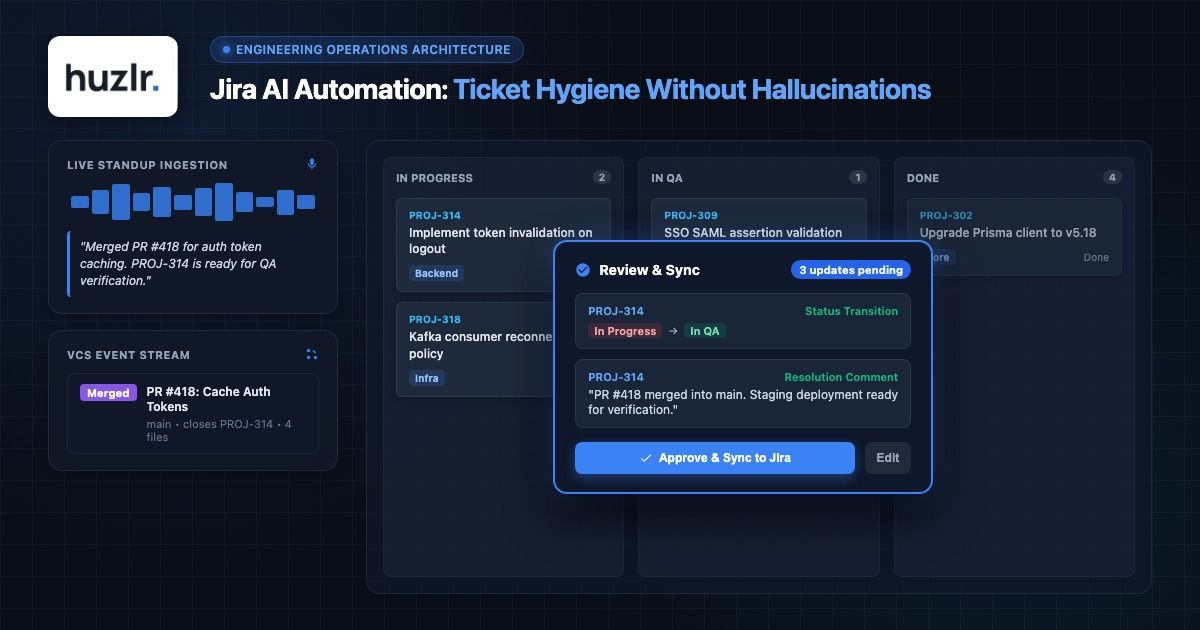
Jira AI automation is an engineering workflow architecture that captures developer activity from daily standup discussions, version control events, and pull request reviews to draft, stage, and execute Jira issue updates without manual administrative effort. By combining natural language processing with issue key resolution and human-in-the-loop verification, modern Jira AI agents keep project boards synchronized with real-world technical progress. Unlike unconstrained bots that autonomously write unverified data or legacy rule engines that depend on rigid triggers, review-first Jira AI automation isolates proposed mutations in staging cards. This architecture allows engineering managers, tech leads, and developers to confirm status transitions, assignees, component labels, and resolution comments with a single click. Consequently, engineering organizations eliminate stale board drift, preserve data integrity across sprint cycles, and free developers from repetitive ticket administration while maintaining complete compliance, security governance, and auditability.
Software engineering organizations rely on Jira as the single source of truth for sprint planning, resource allocation, and milestone forecasting. However, every engineering leader encounters the same universal friction: Jira boards lag operational reality. Developers are hired to architect scalable systems, write production code, and debug distributed services, not to update status dropdowns, tag components, or compose ticket summaries. Over the course of a two-week sprint, this administrative friction accumulates into severe board drift. Issues remain parked in In Progress columns days after code merges, blockers go undocumented in ticket comments, and release managers are left guessing which deliverables are truly production-ready.
The emergence of generative artificial intelligence introduced new possibilities for engineering workflows. Yet early attempts at automating project trackers often created more problems than they solved. Autonomous bots hallucinated ticket details, closed incomplete parent epics, or flooded engineering channels with irrelevant notification spam. True operational velocity requires an intelligent copilot that eliminates manual administrative toil without sacrificing board integrity. By pairing ambient event capture with a review-first architecture, teams can maintain spotless board hygiene and high delivery confidence across every sprint.
The Ticket Hygiene Trap: Why Engineering Boards Drift From Ground Truth
Ticket hygiene drift is not a cultural defect or a sign of developer negligence; it is the predictable byproduct of high-cognitive engineering focus. When an engineer finishes resolving a complex race condition or optimizing a database query, their immediate priority is pushing commits, opening a pull request, and context-switching to the next blocker. Navigating a complex issue tracker interface to locate an issue key, move a status workflow, adjust estimated story hours, and format a comment is an administrative tax that interrupts deep flow state.
This friction triggers what delivery leads identify as the Ticket Hygiene Trap:
- The 48-Hour Reality Gap: Commits and pull requests advance continuously in GitHub or GitLab, but Jira ticket statuses update only when an engineer is forced to prepare for a ceremony. As a result, the board reflects the team's historical state rather than current reality.
- Silent Blockers and Hidden Dependencies: During morning syncs, developers verbally describe third-party API delays, infrastructure provisioning stalls, or cross-team pull request queues. Because nobody records these spoken impediments in the ticket comments, cross-functional dependencies remain invisible until delivery deadlines slip. Teams practicing proactive project risk detection recognize that unrecorded blockers are the primary driver of unexpected sprint delays.
- Superficial Standup Interrogations: Instead of using ceremonies to discuss technical design and team alignment, daily standups devolve into status interrogations where managers walk the board to discover what tickets actually represent. Understanding what is an AI Scrum Master highlights how ambient tracking restores high-value coaching to daily meetings.
- Compromised Velocity Metrics: When tickets are updated in batches at the end of a sprint, burndown charts show artificial cliff-hangers, cycle time calculations skew artificially high, and historical planning data becomes unreliable for future roadmap forecasting.
To combat board drift, engineering management often institutes stricter compliance policies, reminders, or dedicated ticket administrators. However, manual policing degrades developer satisfaction and rarely solves the underlying problem. Board hygiene must become an effortless, automated byproduct of normal development activities.
The Architectural Limits of Legacy Jira Automation and Native Summarizers
Many organizations attempt to resolve ticket drift using Atlassian's native rule engine or recently introduced AI summarization features. While useful for basic workflows, these tools possess structural limitations that prevent them from maintaining true board hygiene.
Rigid Triggers in Native Rule Engines
According to the official Atlassian documentation on Jira Cloud automation, native automation relies on deterministic triggers, conditions, and actions (for example, WHEN pull request merged THEN transition issue to In QA). This approach functions effectively when developers adhere to strict branching conventions such as prefixing branch names and commit messages with issue keys like PROJ-102. In practice, however, workflows are messy. Hotfixes bypass branch naming rules, multiple tickets are addressed in a single pull request, or work is discussed verbally without an attached repository event. A rigid rule engine cannot interpret unstructured context, identify implicit dependencies, or infer intent.
Passive Summarization vs Active Workflow Orchestration
Recent features introduced by native platforms (such as Atlassian Intelligence) focus primarily on passive summarization. They generate concise descriptions from long comment threads, summarize customer service tickets, or draft issue descriptions from rough prompts. While valuable for reading comprehension, passive summarizers are fundamentally unsuited for workflow orchestration. They do not proactively listen to team discussions, extract blockers from audio streams, reconcile discrepancies between version control and board states, or prepare actionable status transitions for lead verification.
The Unconstrained Bot Pitfall
Conversely, early autonomous AI agents built on top of the Jira Cloud REST API attempted to execute mutations without human validation. These bots read conversational chat channels or commit logs and directly updated issue fields. The results were frequently chaotic: models misinterpreted sarcasm or speculative discussion as confirmed status changes, assigned tasks to the wrong contributors based on loose keyword associations, or transitioned parent epics to closed states prematurely. Once a team experiences hallucinated mutations on their production board, developer trust collapses immediately.
The Three-Tier Architecture for Hallucination-Free Jira Automation
Eliminating hallucinations while automating administrative hygiene requires separating contextual data collection from final database mutations. Modern AI engineering operations platforms implement a robust three-tier architecture: Context Ingestion, Semantic Resolution, and Review-First Staging.
Tier 1: Multi-Modal Context Ingestion
Ground truth in software development lives across disparate channels: spoken words in virtual meetings, merged pull requests on GitHub or GitLab, code review discussions, and real-time chat threads. The ingestion layer captures these signals continuously:
- Verbal Standup Streams: Ingesting live audio or speaker-attributed transcripts from virtual meetings (such as Google Meet) to extract real-time technical progress and obstacles.
- VCS Webhook Payloads: Monitoring branch creations, commit messages, PR descriptions, review approvals, and merge events from Git repositories.
- Chat and Incident Channels: Observing operational discussions in Slack or Discord where teams coordinate urgent bug triage or infrastructure alerts.
Tier 2: Semantic and Issue-Key Resolution
Raw conversational data is inherently noisy. A developer might say, "I finally wrapped up the redis caching layer and Nirmal approved the PR." The semantic resolution engine processes this statement through three deterministic steps:
- Entity Recognition: Identifying the spoken task, matching the mentioned engineer to their team identity, and recognizing technical artifacts like repository names or caching components.
- Issue Key Correlation: Querying active sprint boards through the Jira REST API to map the verbal statement to candidate issue keys (for example, PROJ-412: Implement Redis Cache for Session Store). If an explicit issue key is already present in a linked Git commit or branch, the engine verifies the link deterministically.
- Intent Classification: Determining the appropriate mutation type, such as status transition, assignee update, blocker logging, or comment logging.
Tier 3: Review-First Staging and Human Verification
The core safeguard against AI hallucinations is the review-first staging layer. The system never executes direct writes to Jira without explicit human confirmation. Instead, proposed mutations are isolated in a staging queue and formatted as an interactive review card. The engineering lead, Scrum Master, or authoring developer reviews the exact proposed changes, including status movements, field updates, and generated comments, with clear diff badges. A single click confirms the update, dispatching authenticated API calls to Jira. This architecture guarantees that human judgment governs all database updates while reducing administrative work from minutes of typing to a two-second verification.
Step-by-Step Implementation Workflow: From Spoken Standup to Verified Jira State
To understand how review-first Jira AI automation functions in daily practice, consider a realistic end-to-end sprint workflow powered by our direct Jira integration and intelligent meeting agent:
Step 1: Ambient Meeting Facilitation
During the morning standup, an ambient agent such as an AI Scrum Master joins the scheduled video call. As an engineer shares their daily update, they say: "Yesterday I finished the SSO SAML token refresh logic in PR 389. It passed automated integration tests and is deployed to staging. Today I am picking up PROJ-450, but I am blocked waiting for DevOps to grant KMS decryption permissions."
Step 2: Real-Time Extraction and Blocker Triage
Within seconds of the engineer speaking, the intelligence engine parses the update into distinct operational components:
- Work Item 1 (PROJ-309): SAML token refresh completed, PR #389 merged, deployed to staging. Target status: In QA or Staging Verification.
- Work Item 2 (PROJ-450): Work started, assigned to speaker. Target status: In Progress.
- Blocker Detected: KMS decryption permissions missing, dependency on DevOps team. The system structures this impediment into a standardized engineering blocker log template with an explicit resolution owner and next step.
Step 3: Staged Mutation Card Generation
Immediately following the standup, the system posts an interactive review card directly to the team's private Slack or Discord channel. The card displays concise summaries with visual change indicators:
- PROJ-309: Transition from 'In Progress' to 'In QA'. Add comment: 'PR #389 merged to main and deployed to staging environment.'
- PROJ-450: Add Blocker Flag: 'Waiting for DevOps KMS decryption key permissions.' Mention DevOps lead.
Step 4: One-Click Approval and Deterministic Execution
The Scrum Master or Tech Lead reviews the card. If an update requires tweaking, they can edit the comment text or adjust a field in place. When satisfied, clicking 'Approve All' triggers the Jira Cloud REST API over a secure, authenticated connection. The board updates immediately, audit logs record the approval, and the team moves forward without anyone opening a single Jira tab.
Step 5: Automated Stakeholder Reporting
Because board data is updated reliably every day, engineering managers no longer need to spend Friday afternoons manually collecting status emails. The system leverages verified sprint records to automate project status reports, generating accurate milestone summaries for executive leadership that reflect real technical accomplishments rather than outdated estimates.
Comparing Approaches: Manual Updates, Native Rules, Unconstrained Bots, and Review-First AI
Engineering leaders evaluating automation strategies must balance speed against data integrity. The following comparison highlights key differences across the four primary methodologies:
- Manual Developer Updates: Highly accurate when completed, but suffers from low developer engagement, high administrative toil (costing 15 to 30 minutes daily per engineer), and chronic 24 to 48 hour board lag. Relies entirely on developer memory and manual enforcement.
- Native Jira Automation Rules: Fast execution for simple deterministic events (such as branch creation matching issue keys), zero hallucination risk, but completely blind to spoken context, meeting discussions, and messy branch conventions. Requires complex regex maintenance and offers no natural language understanding.
- Unconstrained AI Bots: Autonomous updates driven by generative AI models reading text prompts. Eliminates manual effort initially, but carries high hallucination risk, frequently mutates incorrect issues, lacks auditability, and leads to rapid loss of team trust.
- Review-First Jira AI Automation: Captures multi-modal context (spoken standups, PRs, chat), matches issues semantically, and stages all mutations in interactive cards. Requires zero developer context switching while guaranteeing 100 percent human oversight, zero hallucinations, and complete audit trail compliance.
By combining automated context capture with human approval gates, review-first automation resolves the false dichotomy between administrative speed and board accuracy.
Auditability, Security, and Enterprise Governance in Jira AI Automation
Deploying AI systems into enterprise software development environments requires uncompromising security, privacy, and compliance standards. Jira boards contain proprietary architectural details, security vulnerability disclosures, internal employee records, and business roadmap strategies. Enterprise automation must enforce five core governance guardrails:
1. Least-Privilege OAuth and Scoped API Tokens
AI integrations should never use generic administrative credentials or shared API keys. In accordance with the Jira Cloud REST API security standards, connections must be established via OAuth 2.0 (3LO) or dedicated service accounts scoped strictly to the specific projects and permissions required (such as read/write access to issues and comments, with administrative settings restricted).
2. Immutable Mutation Audit Trails
Every automated action performed on a Jira issue must maintain complete traceability. When a staged mutation is approved, the API payload must record both the AI model attribution and the human approver identity in the issue change history. If a question arises during a sprint audit or compliance review, team leads can easily inspect who spoke the update, which AI pipeline generated the card, and who clicked approve.
3. Strict Zero-Data Retention for Model Training
Technical discussions and issue descriptions must never be used to train public or shared artificial intelligence foundation models. Enterprise-grade AI platforms enforce strict zero-data-retention agreements with underlying infrastructure providers, ensuring that internal source code references, credentials, and technical conversations remain completely isolated within the organization's boundary.
4. Hard Boundaries Against Sensitive Field Mutations
Certain fields in Jira must remain strictly human-governed. High-integrity automation platforms enforce hard operational boundaries: the AI agent is barred from modifying story point estimates, deleting issues, changing sprint start and end dates, or altering security classification levels. Sizing, planning commitments, and access permissions remain the exclusive domain of engineering leadership as outlined in the authoritative Scrum Guide.
5. SOC 2 Type II and End-to-End Encryption
All audio streams, transcripts, and API communication must be encrypted using TLS 1.3 in transit and AES-256 at rest. Systems processing engineering communications should maintain third-party SOC 2 Type II certification to ensure adherence to industry-standard data handling and security operational controls.
The Future of Frictionless Engineering Operations
Software engineering thrives when teams spend their creative energy solving challenging architectural puzzles, building delightful user experiences, and shipping reliable systems. The administrative overhead of modern project tracking tools was never meant to become an obstacle to developer productivity. Jira AI automation, built on a disciplined review-first architecture, bridges the gap between fast-paced technical discussions and rigorous project governance.
By capturing ambient standup context, extracting actionable delivery blockers, and staging verified issue updates for quick human approval, engineering teams can eliminate ticket hygiene drift permanently. Developers stay focused in flow state, engineering leads gain dependable real-time visibility, and sprint boards finally reflect the true state of software delivery.
Ready to eliminate ticket hygiene drift and keep your Jira boards spotless without manual policing? Discover how Huzlr automates sprint tracking through our direct Jira integration and intelligent ambient copilot. Explore Huzlr for Jira today.