
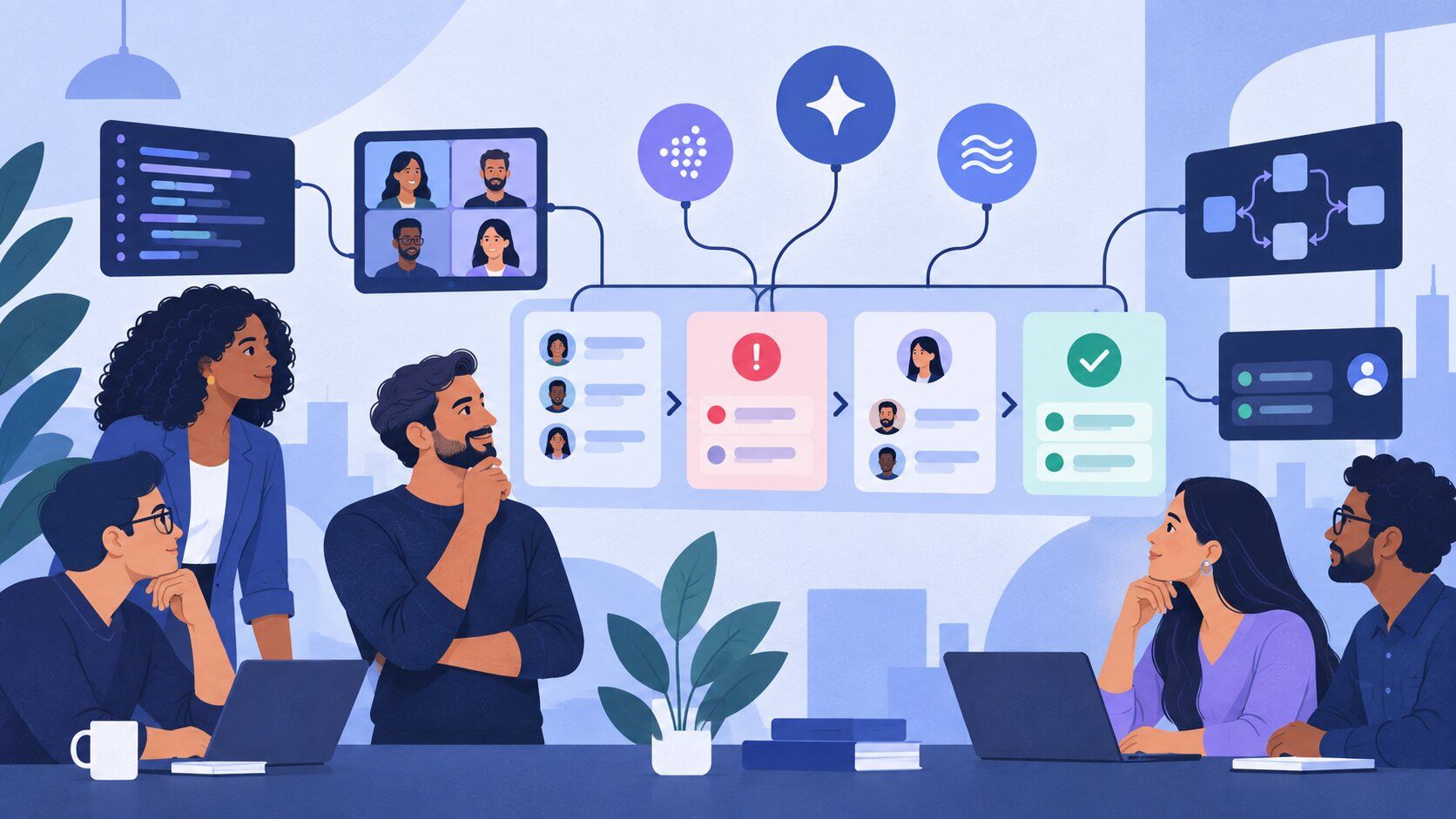
Managing hybrid human-AI workflows is becoming a founder-level operating problem. AI agents can now research repositories, change code, run tests, and prepare pull requests. But faster execution does not automatically create alignment. Without a shared coordination system, founders and engineering leaders still spend their time asking what changed, what is blocked, and who needs to act next.
The answer is not another status meeting. It is a coordination layer that turns work signals into reviewable next actions.
Why Hybrid Teams Create More Status Chasing
At a Series A startup, complexity grows faster than headcount. More customers create more commitments, more engineers create more dependencies, and AI agents create another stream of work to supervise.
The problem usually appears in three places:
- Context fragmentation: The ticket shows “in progress,” the standup reveals a dependency, and the code repository shows no recent movement.
- Unclear ownership: An AI agent completes a task, but nobody owns review, approval, or the next handoff.
- Manual interpretation: A founder or engineering manager must reconstruct the real project state across meetings, messages, and tools.
This is not simply a Jira problem. Jira can run event-driven automations when work items change, as Atlassian’s automation documentation explains. But rules inside one system cannot automatically understand the full meaning of a standup decision, a delayed review, and an AI-generated pull request.
Managing Hybrid Human-AI Workflows as One System
A useful AI coordination layer should connect three operational loops.
1. Observe the work
The system gathers signals from project records, meetings, and engineering activity. This matters because AI work is increasingly asynchronous. For example, GitHub’s Copilot cloud agent documentation describes agents that can research a repository, plan work, make code changes, and prepare a pull request in the background.
That creates valuable output, but it also creates a new management question: who reviews and advances the work?
2. Turn signals into accountable actions
The coordination layer should distinguish among:
- observed progress
- stated blockers
- decisions requiring human judgment
- proposed actions
- missing owners or dates
It should not treat an agent’s output as proof that a business commitment is complete. The NIST AI Risk Management Framework emphasizes governance and risk management around AI systems. For founders, the practical implication is simple: define where AI can act, where a person must review, and who remains accountable.
3. Push exceptions to the right person
Founders should not read every transcript or inspect every ticket. They should see exceptions: unresolved dependencies, work waiting for review, unclear ownership, and decisions that could affect customers or delivery.
A Huzlr coordination workflow is built around this reviewable loop: hold project context, capture enabled Google Meet standup outputs, connect blockers and decisions to that context, and let people confirm owners, dates, risks, and updates.
From Manual Chasing to Coordinated Execution
| Scenario | Manual coordination | Coordination-layer approach |
|---|---|---|
| Standups | Someone takes notes and follows up later | Blockers, decisions, and proposed actions become reviewable records |
| AI-generated work | A person manually tracks agent output | The output returns to a named review and approval step |
| Delivery risk | Leaders discover problems through escalation | Explicit blocker signals are carried forward for intervention |
| Status reporting | Contributors restate work for each update | Existing evidence is assembled into a reviewable status draft |
Google Cloud’s DORA research on AI-assisted software development evaluates AI use across coding, testing, review, documentation, toolchains, and cross-functional coordination. That scope reinforces a useful founder insight: AI adoption is not just a developer-tool decision. It changes the operating system around software delivery.
What Series A Founders Should Implement First
Start with one workflow where status chasing is already painful, such as the daily engineering standup or weekly delivery update.
- Define the sources that count as evidence.
- Assign a human owner for approvals and customer-facing commitments.
- Capture blockers, decisions, owners, and next actions in a consistent format.
- Route only exceptions to founders and senior leaders.
- Measure whether follow-up questions, stale updates, and missed handoffs decline.
Do not begin by granting agents broad authority across every tool. Begin with visibility, review, and a clear escalation path. Then expand automation as the workflow proves reliable.
Stop Managing Updates. Start Managing Exceptions.
AI can increase engineering output, but growing startups win by coordinating that output into dependable execution. When context, ownership, and review remain visible, engineers spend less time reporting work and leaders spend more time removing constraints.
Huzlr is currently in private beta. Its available foundation combines project records with controlled Google Meet standup workflows and reviewable outputs. Broader cross-tool synchronization, automated reporting, and predictive delivery intelligence are still being validated rather than presented as generally available.
Request private-beta access to Huzlr and help shape a coordination layer designed for teams where humans and AI build together.