
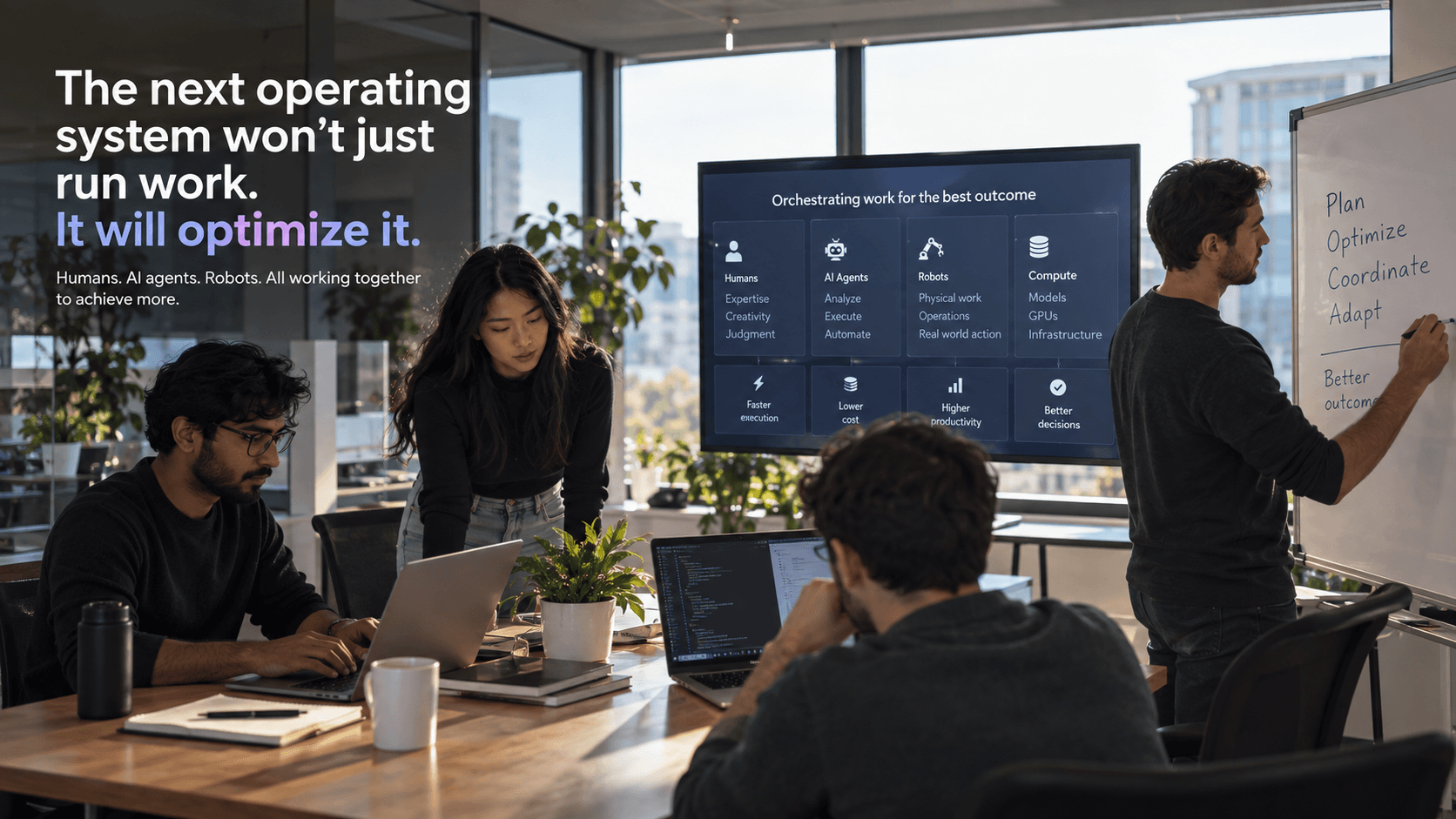
For decades, software has helped us organize work.
We built project management tools to organize people.
We built databases to organize information.
We built automation to reduce repetitive work.
Now we're building AI agents to perform the work itself.
But the next challenge is bigger.
Who decides how all of these resources should work together?
Imagine telling a system:
"Ship 10,000 units by Friday within this budget."
A task-oriented agent might create a checklist and start executing.
An intelligent orchestration system would ask something very different:
- How much human time should this require?
- Which AI agents should handle which activities?
- Which robots should be deployed?
- How much compute should be spent?
- What inventory and logistics capacity are available?
- What happens if one resource becomes unavailable?
- What trade-offs maximize the probability of achieving the outcome?
The difference is subtle, but enormous.
One system completes tasks. The other optimizes an economy of work.
Humans Don't Just Complete Tasks. They Optimize Resources.
Consider a simple situation.
You need to travel 10 kilometers.
You could walk.
You could take a bus.
You could drive.
You could take a taxi.
All four can achieve the same basic outcome: getting you to the destination.
But humans don't choose based only on whether the task can be completed.
We instinctively consider:
- How much time will it take?
- How much will it cost?
- How much effort will it require?
- How much energy will I spend?
- What resources are available?
- What else could I be doing during that time?
In other words, humans don't simply optimize for completion.
We optimize for outcomes under constraints.
That distinction becomes incredibly important as we build autonomous systems.
Today's Agents Are Mostly Task-Oriented
Imagine telling an AI agent:
"Resolve this customer issue."
The agent can reason about the steps required.
It might search the knowledge base, inspect the customer's account, generate a response, update a ticket, and close the issue.
The task is complete.
But what if there were ten possible ways to resolve the issue?
What if one takes 30 seconds and another takes 30 minutes?
What if one requires five expensive model calls?
What if another requires a human to intervene?
What if the customer is strategically important?
What if solving the problem immediately could reduce the chance of churn?
Suddenly, "complete the task" isn't enough.
The agent needs to understand the cost of execution and the value of the outcome.
That is a fundamentally different problem.
NIST's AI Agent Standards Initiative similarly highlights the growing capabilities of autonomous agents and the importance of interoperability, security, identity, authorization, and reliability.
From Task Execution to Resource Optimization
The next generation of intelligent systems may need to reason across multiple dimensions simultaneously.
Time
How quickly can the outcome be achieved?
Compute
How many model calls, tokens, GPUs, or other computational resources are required?
Human attention
Does this require a person, and if so, could their time be better spent elsewhere?
Physical resources
Does the task require machines, vehicles, equipment, energy, or materials?
Financial resources
What does each execution path cost?
Risk
What happens if the system chooses the wrong path?
Opportunity cost
What other valuable work could these resources perform instead?
The objective therefore changes from:
"How do I complete this task?"
to:
"What is the best way to achieve this outcome given the resources and constraints available?"
This is increasingly relevant as AI moves from isolated assistants toward systems that can reason, plan, use tools, and act across workflows. NIST's AI Agent Standards Initiative identifies interoperability across the digital ecosystem as an important challenge for autonomous agents.
Now Add Robots
This becomes even more interesting when AI agents leave the software world.
Imagine a warehouse where humans, software agents, and robots work together.
A customer order comes in.
An AI agent processes the order.
A software system checks inventory.
A robot retrieves the products.
A human performs quality control.
Another system schedules delivery.
Today, each of these activities may live inside a different system.
The warehouse management system knows about inventory.
The robotics system knows about machines.
The HR system knows about employees.
The project or task system knows about work.
The financial system knows about costs.
But none necessarily has a complete understanding of the economic system of work.
An intelligent orchestration layer could potentially understand all of them.
It could know:
We need to ship 10,000 units by Friday.
It could also know:
We have six robots, twelve available workers, three software agents, limited delivery capacity, a fixed budget, and several operational constraints.
Now the problem isn't task management.
It's resource allocation.
Recent research from McKinsey on people, AI agents, and robots frames the emerging workforce as a partnership among people, AI agents, and robots, while emphasizing the need to redesign how work is organized.
What Happens When Reality Changes?
This is where static workflows begin to break down.
Suppose Robot 3 stops working.
A traditional system might report:
Robot 3 offline.
A task management system might mark several tasks as blocked.
A human manager then has to figure out what to do.
An intelligent orchestration system could instead reason:
Robot 3 is unavailable. Can the deadline still be met?
It evaluates the available resources.
Perhaps Robot 4 can take over part of the workload.
An AI agent can handle documentation that a human was going to perform.
A human can move temporarily into quality control.
A delivery route can be adjusted.
The customer can be notified.
The system continuously recalculates the plan based on the new reality.
The important capability isn't simply automation.
It is adaptation.
NIST's 2026 Roadmap for Artificial Intelligence and Machine Learning in Smart Manufacturing explores AI-enabled autonomy, robotics, supply-chain optimization, and adaptive industrial systems, while also highlighting challenges around heterogeneous systems, reliability, and trustworthy operation.
The New Interface May Be Intent
This also changes how humans interact with software.
Today, we often translate our intentions into actions inside applications.
We open Jira.
We create a ticket.
We assign someone.
We change a status.
We send a message.
We update a spreadsheet.
We check a dashboard.
We schedule a meeting.
The software becomes the interface through which we execute our intent.
But if agents become capable of operating those systems themselves, humans may increasingly express the outcome rather than manually execute every step.
Instead of:
"Create these tasks, assign them, update the statuses, schedule the meeting, and follow up with the team."
We might simply say:
"Get this delivered by Friday within this budget."
The intelligent layer determines how.
The existing applications don't necessarily disappear.
They become capabilities and systems of record that the intelligent layer operates.
The human interface moves one level higher.
So Do Traditional Software Applications Become Irrelevant?
Probably not.
Jira can still remain the system of record for engineering work.
Salesforce can still remain the system of record for customers.
ERP systems can still manage financial and operational data.
Robotics platforms can still control machines.
The important change may be who interacts with them.
Instead of humans spending their days navigating every application, agents may increasingly operate those applications on their behalf.
The UI doesn't necessarily disappear.
Its role changes.
It moves from:
"This is where you perform the work."
toward:
"This is where you understand, supervise, approve, and intervene in the work."
That distinction could become one of the defining shifts in enterprise software.
The Missing Layer: An Economy of Work
This leads to a bigger question.
What if an intelligent system could treat every available resource as part of a single economy of work?
Humans have:
- Time
- Skills
- Attention
- Availability
AI agents have:
- Compute
- Model capabilities
- Tools
- Execution limits
Robots have:
- Physical capabilities
- Battery
- Location
- Operating time
Organizations have:
- Capital
- Inventory
- Infrastructure
- Deadlines
- Customers
- Risk constraints
The operating system of the future could potentially reason across all of them.
Not merely:
"Who is assigned to this?"
But:
"What combination of humans, agents, machines, time, energy, and capital should be allocated to achieve this outcome?"
That is a much bigger question.
NIST's work on Intelligent Building Agents provides an example of this principle: agents can monitor system performance and collaborate toward objectives such as minimizing operating costs or maximizing desired outcomes.
The idea can now be extended far beyond buildings.
From Management Software to an Operating System for Work
The software industry has historically created specialized systems.
One system manages projects.
Another manages customers.
Another manages finances.
Another manages employees.
Another manages machines.
Another manages communication.
But the real world doesn't operate in those boundaries.
A customer issue can involve a salesperson, an AI agent, a support engineer, a database, a robot, a payment system, and a logistics provider.
The outcome crosses applications.
The workforce crosses applications.
The resources cross applications.
The intelligent layer therefore needs to cross applications too.
This is where an operating system for work becomes an interesting concept.
Not an operating system in the traditional sense of managing CPUs and memory.
An operating system that manages intent, intelligence, resources, and execution.
The Ultimate Optimization Problem
The goal isn't necessarily to minimize everything.
The cheapest solution isn't always the best solution.
The fastest solution isn't always the best solution.
The most automated solution isn't always the best solution.
A good system needs to understand trade-offs.
For example:
Minimize cost
while meeting the deadline
while maintaining quality
while respecting safety
while keeping human intervention within acceptable limits.
That becomes an optimization problem.
And the more capable AI and robotics become, the more important this problem could become.
Because when machines can perform more of the world's work, the bottleneck may no longer be execution.
It may be deciding where intelligence and resources should be allocated.
The Future May Be About Orchestrating Intelligence
We spent the last few decades building software that helped humans perform work.
Then we started building AI that could perform pieces of that work.
Now we're entering a world where multiple kinds of workers can coexist:
Humans.
AI agents.
Robots.
The next challenge is making them work as one system.
That requires more than automation.
It requires context.
It requires memory.
It requires coordination.
It requires understanding constraints.
It requires understanding economics.
And ultimately, it requires continuously answering one question:
Given what we are trying to achieve and everything we have available, what should happen next?
That may be the foundation of the next generation of work software.
The future operating system may not simply run applications.
It may orchestrate intelligence itself.
Building Toward That Future
This is the space Huzlr is exploring.
The idea is simple at its core:
Work should not require humans to manually coordinate every person, system, and intelligent worker involved in achieving an outcome.
As organizations move toward hybrid workforces made up of humans, AI agents, and eventually physical machines, there is an opportunity for an intelligent coordination layer that understands the work, the available resources, and what needs to happen next.
The long-term question isn't just how to build better agents.
It is:
How do we build systems that can orchestrate intelligence toward outcomes?
Huzlr is building toward that future.