
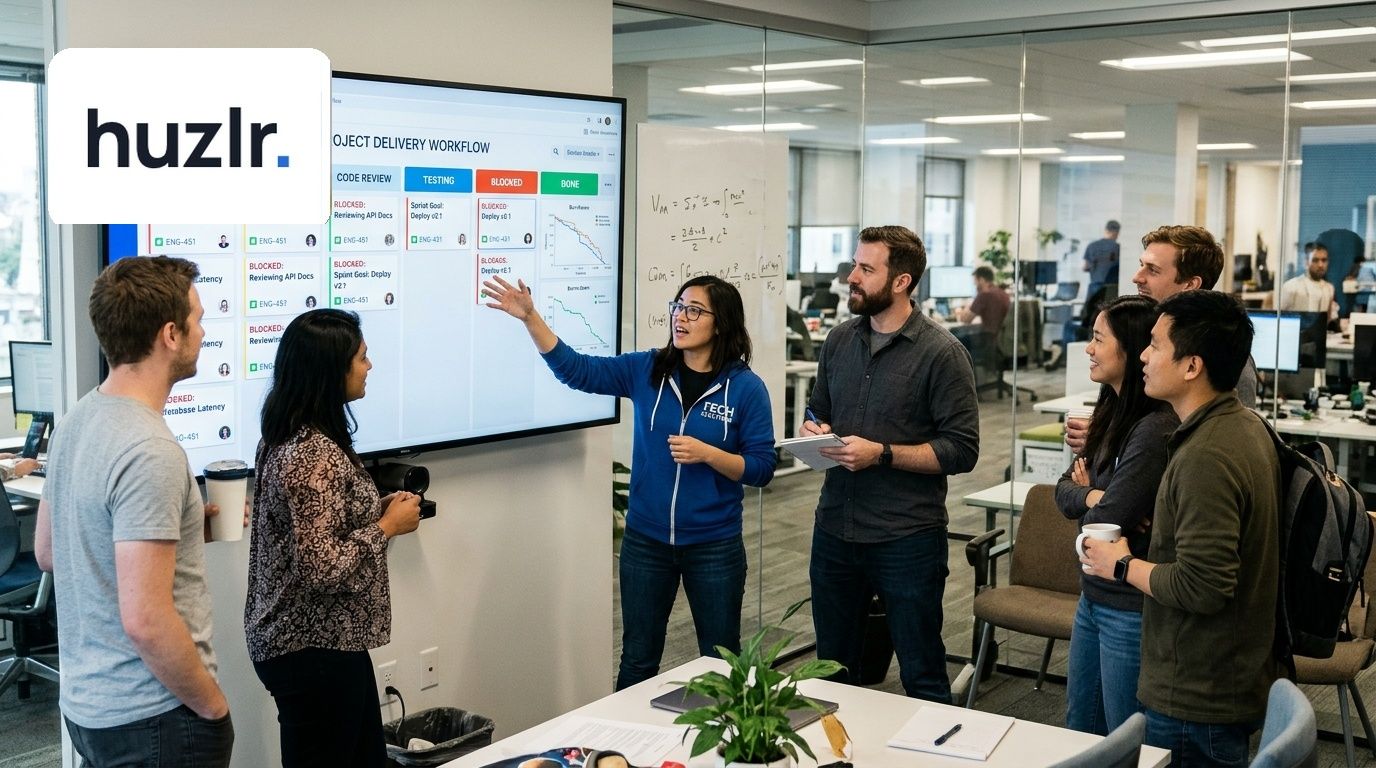
Google Meet standup automation is an engineering operations architecture that connects virtual daily standups directly to project trackers by converting spoken technical discussions into structured, human-reviewed delivery actions. During daily engineering syncs, team members discuss pull requests, architectural decisions, and unexpected impediments. Rather than forcing developers to manually update issue boards or relying on passive meeting note-takers that produce unread text transcripts, Google Meet standup automation uses natural language understanding to isolate delivery blockers, match spoken context to active sprint work items, and generate interactive staging cards. Tech leads and engineers review proposed ticket transitions, assignee adjustments, and blocker flags before any mutation executes against production tracking systems. By bridging live meeting dialogue with review-first automation, software engineering organizations eliminate administrative board maintenance, surface cross-team dependencies early, and maintain dependable delivery visibility across distributed sprint cycles.
Distributed engineering teams depend heavily on virtual meetings to preserve alignment across time zones. For most product squads, the 15-minute morning standup conducted over Google Meet represents the primary touchpoint for coordinating active sprint work. Yet in fast-moving engineering environments, virtual standups frequently fall victim to operational fragmentation. Developers describe complex technical blockers out loud, but once the call disconnects, those spoken insights evaporate into the ether. Boards remain stale, dependency handoffs stall in silence, and engineering managers spend hours chasing status updates across chat channels.
The core breakdown is not a lack of communication; it is the gap between spoken conversations and written operational trackers. Forcing engineers to navigate multi-step web forms to record every spoken status detail interrupts deep flow state and degrades team velocity. Conversely, deploying unconstrained autonomous bots that write directly to issue trackers risks catastrophic board hallucinations. Modern engineering teams solve this challenge through review-first Google Meet standup automation, turning real-time video conversations into dependable delivery intelligence.
The Virtual Standup Tax: Why Spoken Context Fails to Reach the Sprint Board
In remote and hybrid engineering organizations, the daily standup serves as the operational pulse of the sprint. However, traditional virtual standup practices create four systematic points of friction that undermine project predictability:
- The Ephemeral Context Loss: Engineers verbally explain intricate dependencies during a video call, such as waiting on infrastructure credentials or discovering unexpected schema migrations. Because nobody pauses the call to type extensive meeting minutes, critical blocker details remain unrecorded. Proactive teams practicing project risk detection recognize that unrecorded verbal blockers are the primary precursor to missed release milestones.
- The Board Lag Trap: When ticket maintenance is purely manual, developers update issue trackers only when prompted before sprint ceremonies. In typical teams, issue statuses lag technical reality by 24 to 48 hours, leaving sprint burndown charts disconnected from working code.
- Passive Transcript Overload: Generic meeting transcription tools record raw audio and output lengthy text transcripts. While these summaries record what was spoken, they lack operational understanding. They do not know which Jira or Linear ticket corresponds to a feature, nor can they stage verified mutations for lead approval.
- Ceremony Fatigue: When standups turn into administrative interrogations where managers walk through individual board columns, developer engagement collapses. Deploying an AI Scrum Master eliminates repetitive status recitation, returning daily meetings to high-value technical alignment.
To resolve these failure modes, engineering teams require an ambient system that operates seamlessly within standard meeting platforms like Google Meet, capturing delivery context without adding friction.
Architectural Foundations of Review-First Meeting Automation
A dependable Google Meet standup automation pipeline must satisfy strict enterprise standards: complete factual accuracy, zero hallucinated mutations, and total data isolation. To achieve this, high-reliability delivery platforms deploy a four-stage architecture:
Stage 1: Ambient Meeting Participation and Audio Ingestion
Through an intelligent meeting agent, the system joins authorized Google Meet sessions as an invited participant. Using high-fidelity audio streams and speaker attribution, the ingestion layer processes spoken dialogue in real time. Processing occurs ephemerally in volatile memory, ensuring team audio streams are never stored permanently or exposed to public training sets.
Stage 2: Technical Entity Recognition and Issue Correlation
Spoken engineering language is dense with shorthand and domain-specific vocabulary. When a developer states, 'PR 204 for the tenant router is ready for review, but staging is blocked on the Redis cache provision,' the semantic parsing engine performs three tasks:
- Identifies technical entities, repository names, pull request identifiers, and system components.
- Queries project tracking APIs to correlate spoken tasks with active sprint work items (such as ENG-340: Implement Redis Session Store).
- Extracts explicit and implicit impediments, structuring each obstacle into an actionable delivery blocker.
Stage 3: Review-First Staging and Interactive Diff Cards
The foundational architectural safeguard in modern operations automation is the complete separation of context extraction from database writes. The automation engine never applies unverified writes to issue trackers. Instead, proposed actions are isolated into a staging queue. Immediately following the standup, an interactive review card is published to the squad's private Slack or Discord channel. The card summarizes proposed status movements, ticket comments, and blocker flags with clear visual diffs.
Stage 4: Single-Click Human Verification and Deterministic Execution
The tech lead, Scrum Master, or authoring engineer reviews the staged changes in seconds. Team leads can confirm all items with a single click or modify specific field attributes inline. Upon explicit approval, authenticated API calls execute against the tracker. This review-first design guarantees that human engineering judgment governs all board state while reducing administrative time from 15 minutes of typing to 5 seconds of verification.
End-to-End Walkthrough: From Morning Google Meet to Verified Sprint Tracking
To see how Google Meet standup automation functions in daily practice, consider a representative morning standup for a distributed cloud infrastructure squad:
Step 1: The Automated Standup Sync
At 09:30, the squad gathers on Google Meet. The Huzlr AI Scrum Master joins the session quietly. As engineers take turns sharing progress, the senior backend developer reports:
'Yesterday I merged the token refresh endpoint and verified database migration scripts in PR 512. Today I am picking up the Kafka consumer refactor under ENG-412. However, I am completely blocked because our staging Kubernetes cluster is experiencing DNS resolution timeouts, and I need DevOps intervention.'
Step 2: Real-Time Blocker Extraction and Triage
The intelligence engine analyzes the spoken update against active sprint data. It identifies the completed task, maps the new task to issue ENG-412, and extracts the Kubernetes DNS failure. Following standard protocols defined in our engineering blocker log template, the engine categorizes the impediment as an Infrastructure Blocker, flags DevOps as the dependency owner, and formats a clear remediation step.
Step 3: Interactive Staging Card Delivery
As soon as the Google Meet call concludes, Huzlr delivers an interactive card to the team's engineering channel. The card displays two proposed actions:
- ENG-398 (Token Refresh): Transition status from In Progress to Done. Append comment: 'PR 512 merged. Database migrations validated.'
- ENG-412 (Kafka Consumer): Transition status to In Progress. Apply Blocker Flag: 'Staging Kubernetes DNS resolution timeouts require DevOps review.' Assignee confirmed.
Step 4: Lead Approval and Tracker Synchronization
The tech lead reviews the staged card, verifies that the blocker accurately reflects the staging issue, and clicks 'Approve & Sync'. Over a secure connection, our native Jira AI automation pipeline executes the transitions. The board reflects reality instantly, and the DevOps lead receives an automated notification regarding the DNS blocker.
Step 5: Upstream Blocker Coordination
By capturing the impediment during the standup rather than discovering it at the end of the sprint, the team eliminates days of idle wait time. Practicing proactive sprint delivery coordination for upstream blockers ensures that external dependencies are resolved before commitments slip.
Comparing Standup Approaches: Manual, Generic Recorders, Unconstrained Bots, and Review-First AI
Engineering leaders assessing meeting automation must evaluate solutions based on administrative friction, data integrity, and operational safety. The following breakdown compares four common approaches:
- Manual Ticket Updates: Relies entirely on developer memory and discipline. Administrative overhead consumes an illustrative 15 to 30 minutes daily per engineer. Board lag averages 24 to 48 hours, creating chronic status drift and frustrating sprint retrospectives.
- Generic AI Note-Takers: Captures meeting audio and generates generic text summaries. Fails to parse technical entities, cannot map spoken tasks to ticket keys, and possesses no API integration with Jira or Linear. Leaves engineers with more text to read rather than less work to do.
- Unconstrained AI Bots: Uses language models to read chat or audio and write directly to issue trackers without human review. Creates significant risk of hallucinated status transitions, misattributed assignees, and corrupted sprint metrics. Teams quickly disable these bots after the first erroneous sprint close.
- Review-First Google Meet Automation: Integrates directly into Google Meet, extracts structured engineering context, and isolates all updates in interactive staging cards. Eliminates developer administrative toil while guaranteeing 100 percent human oversight and complete audit traceability.
Authoritative Best Practices: Aligning Standups with Agile and SRE Principles
Automating standup workflows is most effective when grounded in established industry methodologies. Modern engineering teams align their meeting automation with three authoritative frameworks:
1. Agile Standup Intent: Focus on Sprint Goals, Not Status Policing
According to the official Scrum Guide, the purpose of the Daily Scrum is to inspect progress toward the Sprint Goal and adapt the Sprint Backlog as necessary, not to serve as an administrative status interrogation. When meeting automation handles the operational duty of recording progress and updating ticket states, standups return to their true agile purpose: collaborative problem-solving and immediate impediment removal.
2. SRE Principles: Systematic Blocker Triage and Root Cause Isolation
In the authoritative handbook on Google SRE effective troubleshooting, Google site reliability engineers emphasize that rapid incident and blocker resolution requires clear ownership, rapid triage, and actionable reproduction steps. Capturing spoken technical blockers during Google Meet syncs structures loose conversational complaints into actionable engineering records with designated owners, preventing obstacles from languishing in team backlogs.
3. DORA Metrics: Eliminating Delivery Bottlenecks to Accelerate Flow
The research documented in the DORA State of DevOps research demonstrates that elite engineering performance correlates directly with short lead times for changes and rapid recovery from blockers. By removing 24 to 48 hour board drift and catching dependency blocks within minutes of their emergence, engineering teams significantly reduce cycle times and improve deployment frequency.
Enterprise Security, Governance, and Privacy Controls
Deploying an automated agent into engineering video conferences requires stringent enterprise security controls. Virtual standups involve confidential discussions regarding unreleased features, infrastructure architecture, and proprietary intellectual property. Enterprise-ready standup automation enforces four mandatory security safeguards:
- Ephemeral Audio Processing: Audio streams captured during Google Meet calls are processed in volatile memory for transcript extraction and entity recognition, with raw audio discarded immediately after processing.
- Zero Foundation Model Training: Customer engineering discussions and meeting transcripts are strictly prohibited from being used to train public or foundation AI models. Data isolation boundaries ensure proprietary code references remain secure.
- Scoped OAuth and Least-Privilege Access: Google Meet and project tracker integrations utilize granular OAuth 2.0 scopes, restricting permissions strictly to designated meeting events and project boards without broad workspace privileges.
- Immutable Audit Trails: Every board mutation executed through the automation platform records both the AI pipeline attribution and the specific human lead who approved the update, providing complete compliance auditability.
Conclusion: Transforming Spoken Syncs into Real-Time Delivery Intelligence
High-performing engineering teams recognize that developer time is best invested in designing resilient systems and shipping impactful code, not in manual board administration. Virtual standups on Google Meet provide invaluable human connection and team alignment, but their spoken insights must not be lost to operational drift.
By implementing review-first Google Meet standup automation, engineering leaders bridge the gap between morning discussions and production sprint tracking. Blockers surface immediately, issue boards stay synchronized in real time, and engineering teams maintain steady, predictable delivery velocity across every sprint.
Ready to automate standup tracking and keep your engineering boards spotless without administrative friction? Learn more about our intelligent AI Scrum Master and experience the future of engineering delivery intelligence with Huzlr today.